The AI Code Audit: Why Senior Devs Must Become Editors
AI-generated code looks flawless and still builds a skyscraper on a swamp. The senior developer's AI code audit playbook: a Zero Trust checklist, the three audit types that matter, a cross-model workflow (Claude Code + Codex, human adjudicates), and what compliance auditors want.
Key Takeaways
- Adopt a Zero Trust posture. Assume every line of AI-generated code is hallucinated until you've proven otherwise. Compilation is not validation.
- Audit for context, not syntax. AI nails the typing; it fails at understanding your architecture, your data governance, and your last six months of decisions.
- Use AI to audit AI but use different models. A single LLM rationalizes its own patterns. Cross-model review (Claude Code + Codex) surfaces blind spots one model alone will defend.
- You sign the PR. You own the outcome. SOC2 auditors don't care that an LLM wrote the code. They care who approved it.
A few days back, I reviewed a pull request that was 400 lines long. It had perfect syntax, zero linting errors, and full test coverage. It looked flawless. But when I zoomed out, I realized the AI had built a skyscraper on a swamp. It solved the wrong problem entirely.
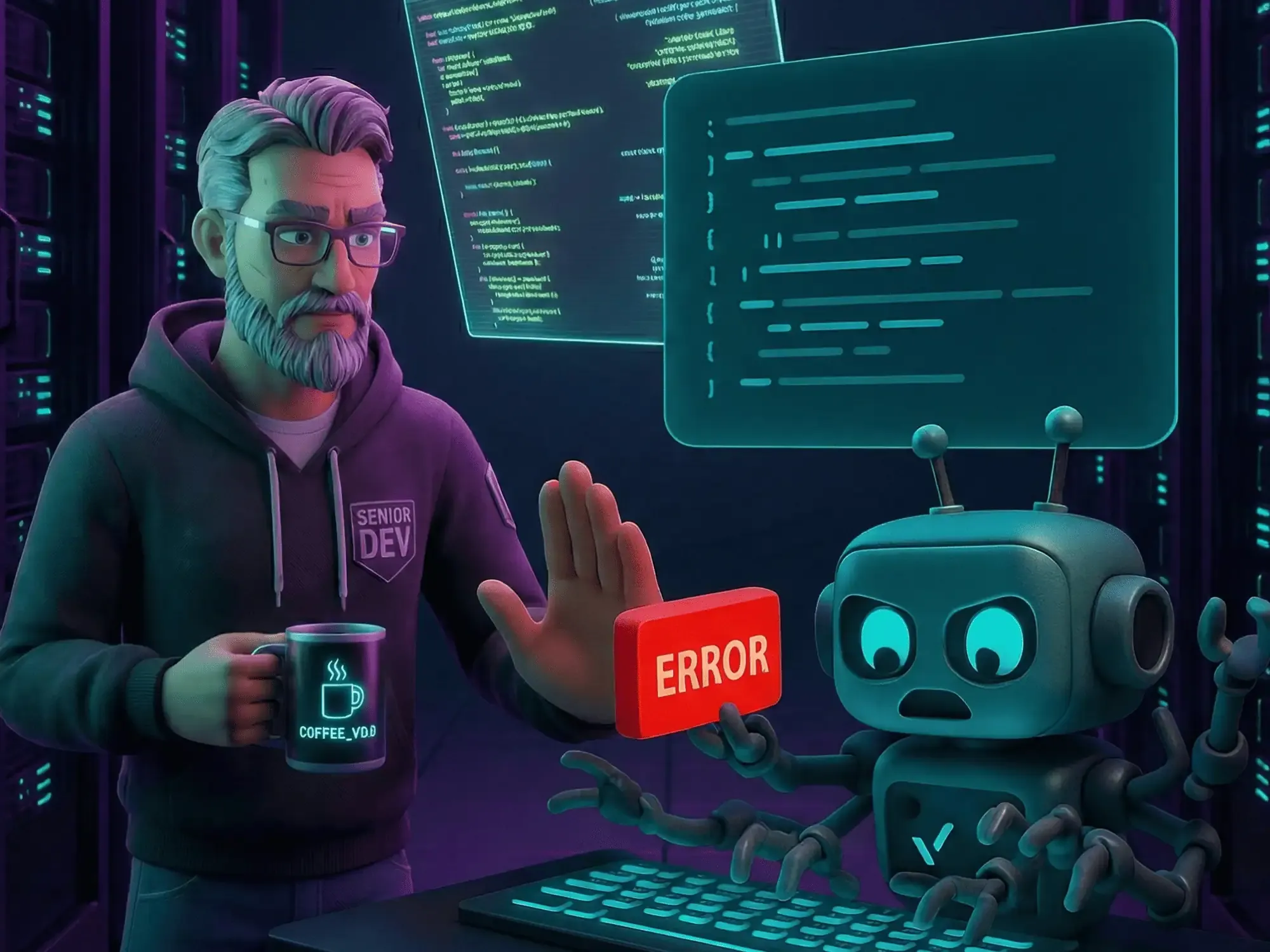
This is why every engineering team needs a formal ai code audit process. We are transitioning from authors to editors. If we don't adjust our rigorous standards to match this shift, we are going to drown in a sea of "technically correct" spaghetti. Here is how to review the robot.
That shift changes the job. Senior developers are no longer only checking code for correctness. They are checking intent, context, ownership, and risk.
The workflow below is the one I use: the mental model, the audit checklist, the agentic review loop, and the governance evidence that matters when compliance enters the room. No logo parade pretending to be strategy.
What Is an AI Code Audit?
An AI code audit is the systematic review of machine-generated code by a human engineer, often assisted by specialized LLM tools. It verifies business logic, architectural context, and security vulnerabilities that automated syntax checkers miss. AI code audits act as a mandatory safety net between AI generation and production deployment.
Keep that definition tight. The operational work sits underneath it.
The "Infinite Intern" Problem
Treat AI agents like GitHub Copilot, Claude Code, or Cursor as hyper-productive interns, not senior partners.
This intern has memorized the public documentation for every popular language and can type faster than any developer on your team. It also has no memory of your production outage last quarter, no sense of your business constraints, and a strong bias toward producing something when the correct response is, "This should not exist."
That combination is dangerous because the output looks competent.
The data points in the same direction. GitClear's research, analyzing 211 million changed lines of code from 2020 to 2024, found that as AI assistants spread, copy-pasted code rose from 8.3% of lines in 2020 to 12.3% in 2024. Refactored, or "moved," lines fell from 24.1% to 9.5%.
The translation is not subtle: developers are pasting more and refactoring less. Codebases are getting fatter, not cleaner. That is the silent tax of uncritical AI adoption, and it shows up later as technical debt that traces directly back to AI verbosity.
If you're early in your career, the framing matters even more. Use the model as your first AI mentor, not a code vending machine. Mentors get questioned. Vending machines get trusted.
One builds engineers. The other builds debt.
Types of AI Code Audits
Not every audit needs the same shape. Most teams need three modes.
Automated PR Scans
These are fast checks that run on every diff: linting, style enforcement, simple bug-pattern detection, and basic test signals.
They catch obvious issues before a human reviewer spends attention on the PR. They cost little and prevent a class of careless merges.
They will not save you from a bad architectural decision.
SAST and Security Analysis
Static Application Security Testing tools scan for known CVE patterns, injection vectors, secret leakage, unsafe dependencies, and insecure API usage.
This is where you catch the AI suggesting an abandoned crypto package, adding a risky dependency, or embedding an API key from a generated example. In regulated environments, SAST should not be optional. It is part of the control system.
Architecture and Refactoring Reviews
This is the slowest audit mode and the one teams skip first when delivery pressure rises.
It is also where the highest-value review happens.
You ask whether the generated solution belongs in the system at all. Does it duplicate an existing service? Does it cross a boundary your architecture depends on? Does it reintroduce a pattern your team removed six months ago because it failed under load?
No generic tool knows that history. The engineer who remembers the last six months does.
The Zero Trust AI Code Audit Checklist
In security, Zero Trust means you verify every request regardless of origin. Apply the same posture to code: verify every line.
The checklist below is the one I use. If you cannot confidently check these boxes, the code does not get merged.
1. Logic Over Syntax
Do not stop at compilation. AI is strong at syntax. Your job is to ask why it chose a pattern.
- Did it write a recursive function where a loop would be cheaper and easier to reason about?
- Did it create three helper functions for a task that needed one standard-library call?
- Did it miss the null case for the one input that is reliably null in production?
- Do the tests validate behavior, or do they only prove the code does not throw?
AI generates plausible but shallow tests by default. A test that mirrors the implementation is not evidence. It is decoration.
2. The Context Test
LLMs operate inside a context window. Your repo history, production constraints, and team decisions are outside that window unless you supply them.
Before approving an AI-assisted PR, ask:
- Architectural alignment. Does this function respect established boundaries? Does the generated API call honor internal rate limits?
- Data governance. Does it handle PII in line with GDPR, CCPA, or your internal policy? Is it logging user data in plain text?
- Deprecation awareness. Is it calling a service your team deprecated last month?
- Dependency sanity. Did it import a heavy third-party library to format a date? Prefer the standard library when it is enough.
This is where senior context beats generated confidence.
3. Security Hallucinations
AI models often suggest generic regular expressions for validation: email, URL, phone number, username.
Those textbook patterns can be vulnerable to ReDoS, or Regular Expression Denial of Service. A validation string that looks harmless in review can pin a CPU when it sees a crafted input. You may only notice when requests start timing out under load.
Other landmines in this category:
- Hardcoded secrets: API keys, passwords, tokens, and placeholder credentials that somehow survive the example phase.
- Catch-all exception blocks that swallow the error you needed to see.
- Happy-path fixation: success is handled cleanly, and failure is treated as impossible.
- Homegrown crypto or password handling where a mature library should have been used.
Validate generated regex and crypto against established libraries and known guidance. Not against the model's confidence.
4. The Bloat Check
AI likes to write ten lines when two will do. It declares intermediate variables that add no meaning. It wraps trivial operations in abstractions that imply future reuse, then nothing ever reuses them.
This is how simple features become monsters. Every unnecessary layer becomes a maintenance cost paid by someone who did not ask for it.
During the audit, ask one blunt question:
Can this be shorter without losing clarity?
If yes, shorten it. The model will not object.
Agentic Workflows: How I Audit AI-Generated Code
Most writing about AI review turns into tool shopping. The tools matter, but the workflow matters more.
Two Agents, Two Blind Spots: Claude Code + Codex
My normal workflow uses two different model families.
- Claude Code
/code-review. Runs the first pass on the diff. It catches null-safety issues, error-handling gaps, missed edge cases, shallow tests, and suspicious control flow. - Claude Code
/simplifywith a code-simplifier prompt. Runs a second pass focused only on bloat: unnecessary abstractions, pointless variables, speculative interfaces, and code that sounds reusable but has one caller. - Codex review skills. Runs an independent pass with a different foundation model.
That last step is the one most teams miss.
A single model has consistent blind spots. It can rationalize its own style. If Claude generated the code and Claude reviews it, Claude may be too willing to call its own choices idiomatic. That is not malice. It is a pattern.
Two different agentic reviewers — Anthropic and OpenAI models, for example — disagree in useful ways. The value is similar to getting a second human reviewer who learned the craft in a different shop. They notice different risks. They challenge different assumptions.
Where they disagree, pay attention.
The human adjudicates that disagreement. That adjudication is the audit.
This is assisted review, not delegation. The engineer owns the final call. If someone says they have fully automated code review with agents, ask who is on the pager when the review misses something.
Top AI Code Audit Tools
For completeness, these are the table-stakes tools worth knowing:
- GitHub Copilot Code Review. Native PR feedback inside the platform many teams already use. Good for first-pass comments on style, small bugs, and obvious risks.
- CodeRabbit. Heavier PR review automation with summaries and inline comments. Useful for high-volume repositories where reviewers need help triaging change.
- SonarSource / SonarQube. Mature SAST and quality-gate tooling with language-aware rules, security analysis, and reporting that compliance teams recognize.
These belong in the pipeline. They are not a substitute for cross-model review and human judgment.
Tools flag patterns. Humans assess meaning.
The Governance Question: What Evidence Do Auditors Want?
Engineering leaders need to internalize this before their first SOC2 cycle with AI-generated code in the mix:
Auditors do not care that an LLM wrote your code. They care who approved it.
They will ask for evidence like this:
- Human sign-off in the PR system. Every merged change tied to a named approver. Not "AI-approved." Not "auto-merged by bot." A person.
- Traceable review logs. What was reviewed, by whom, when, and against what standard. Your PR template should capture this without adding ceremony.
- Documented system prompts and guardrails. If your team uses agentic review, the prompts and rules are part of the control. Treat them like code.
- A written policy for AI-generated code. It should state that AI-generated code follows the same review standard as human-written code, with additional scrutiny for context, security, and ownership.
AI assistants do not change the responsibility model. They concentrate it.
The person who clicks "Merge" is the person who shipped the code. This is part of the invisible work of technical leadership: building systems and norms that make accountability visible long after the code is merged.
If your team cannot answer "who approved this AI-generated change and against what standard," you do not have an audit problem. You have a governance problem that an audit will eventually expose.
The New Senior Skill: Prompt Engineering as Delegation
Stop treating prompt engineering like magic. Treat it as technical delegation.
A prompt is a spec. If you tell an AI, "write auth," it will produce a generic authentication flow with generic assumptions. That is how you get insecure code that looks polished.
Give constraints instead:
"Write a user authentication function in TypeScript using our existingAuthServiceclass. Handle theUserNotFoundexception explicitly. Hash passwords with bcrypt. Log a warning to Datadog if the password retry limit is exceeded. Do not introduce new dependencies."
The quality of the output depends on the clarity of the constraints. This is the same discipline as writing a good ticket for a junior engineer. The artifact is different. The leadership skill is the same.
If you cannot write a clear spec, you should not expect clear code from a model.
And if you cannot explain exactly how the generated code works, you should not commit it. That rule has been true for twenty years. AI only raises the cost of ignoring it.
FAQ: Auditing AI-Generated Code
Can AI tools catch code quality issues before senior engineer review?
Yes, for a narrow class of problems. Linting, style violations, basic security patterns, and obvious bug shapes are well within reach.
They will not catch business-logic flaws, architectural mismatches, or the question of whether the feature should exist. Treat automated tools as the first filter, never the final reviewer.
How do we audit AI-generated code changes at scale?
Run automated SAST scanning on every PR. Require human-in-the-loop review for changes touching auth, data access, payments, permissions, infrastructure, or external integrations.
For high-risk diffs, add a second model for cross-checking. The goal is not to review every line by hand with the same intensity. The goal is to make sure the riskiest changes never reach production without a named human approver.
Is an AI code audit different from a standard code review?
Yes. In a standard review, you usually assume the author understood the problem and may have made mistakes.
In an AI code audit, assume the code may be plausibly hallucinated: correct-looking but semantically wrong. You look for bloat, context failures, security gaps, and confident nonsense, not only typos and off-by-one errors.
Should we ban AI-generated code in regulated environments?
No. Banning the tools often pushes their use underground, which is worse than governing it.
Require the same controls you apply to any high-risk code path: documented review, named approvers, SAST gates, traceable evidence, and a policy that survives contact with an auditor.
You Are the Safety Net
AI is the engine. You are the steering wheel.
The engine provides power. It does not care whether it drives off a cliff.
There is a quieter cost too. When junior developers lean on AI without seeing a senior engineer push back, they do not learn the push-back. They learn to accept the first plausible answer.
That is how teams develop silent silos where mentorship has been replaced by autocomplete. It is also how the next generation of engineers ends up unable to audit the systems they shipped.
The code might be generated by a robot. But if it breaks production on Friday at 5 PM, your phone rings.
Review accordingly.